

Scientists Discover Ocean Plants Can Remove Billions of Tons of Carbon From the Air
Most solutions to climate change need new technology, billions in funding, or decades of political agreements. A new study published in May 2026 suggests our most powerful carbon removal tool might already exist in the ocean — and it has been working quietly for millions of years.
Researchers at the Scripps Institution of Oceanography found that microscopic ocean plants called phytoplankton can absorb carbon dioxide at rates far higher than previously thought. With a small and relatively cheap boost, those rates could increase by up to 300 percent in certain ocean regions.
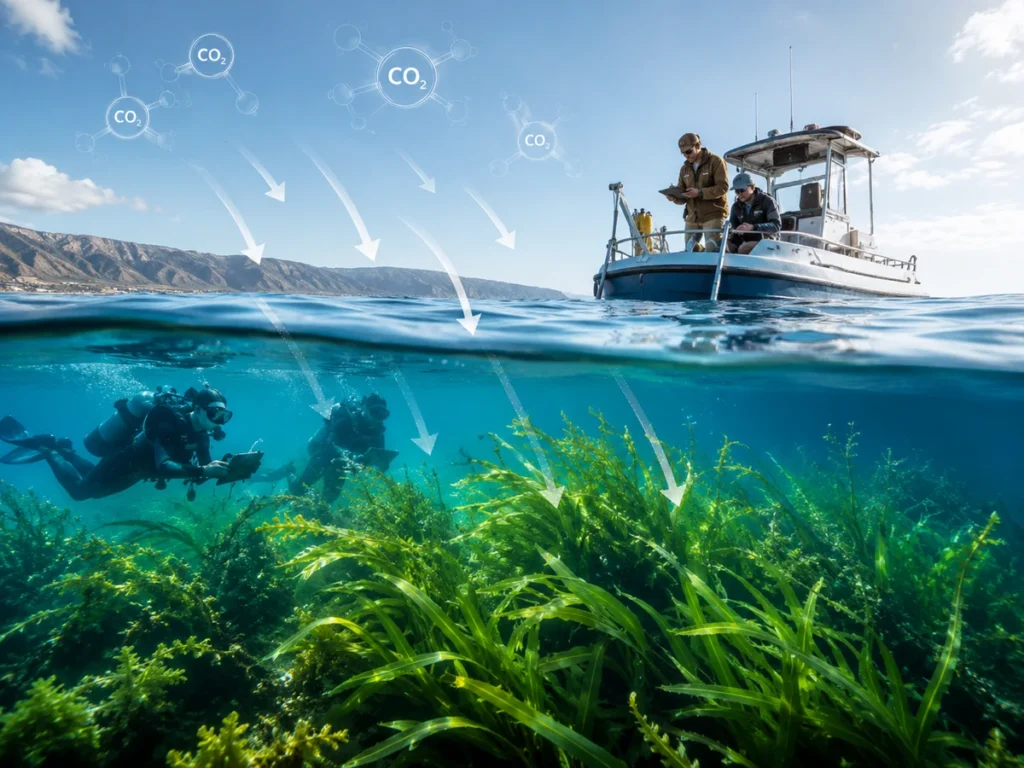
What Are Phytoplankton?
Phytoplankton are single-celled, plant-like organisms that live near the surface of oceans and lakes. They are invisible to the naked eye, but they are everywhere. Like land plants, they use sunlight and carbon dioxide to grow through photosynthesis. When they die, many sink to the ocean floor — taking their stored carbon with them, where it can stay locked away for centuries or longer.
Here is the part that surprises most people: phytoplankton already remove about 25 percent of all human-caused carbon emissions every single year. That is more than all the forests on Earth combined. Scientists have known this for a while. What the new research found is that the system could be doing much more — if it had access to one missing ingredient.
The Missing Ingredient: Iron
Iron is a nutrient that phytoplankton need to grow, but large parts of the ocean are naturally very low in iron. The new study tested what happens when small amounts of dissolved iron are added to these iron-poor regions. The results were striking.
The research team ran controlled experiments in three ocean regions over three years: the Southern Ocean near Antarctica, part of the equatorial Pacific, and a section of the North Atlantic. In each location, they added carefully measured amounts of dissolved iron and monitored the results for six months.
Every time, the same thing happened. Phytoplankton populations grew rapidly. Carbon absorption surged — by up to 300 percent in the test zones. And measurements taken from deep water below 1,000 meters showed that a significant portion of that carbon had sunk to the depths, where it would stay for decades or centuries.
“We ran this in three real ocean environments and got consistent results each time. Nature already has this machinery. We are just learning to work with it more deliberately.”
— Dr. Elena Vasquez, Lead Researcher, Scripps Institution of Oceanography
Is Adding Iron to the Ocean Safe?
This is the question every serious scientist asks first. Ocean iron fertilization is not a new idea — it has been studied since the 1990s. Earlier experiments raised real concerns that researchers are still taking seriously:
- Oxygen depletion: When large phytoplankton blooms die and decompose, the process can consume oxygen in the water below, creating zones where fish and other marine life struggle to survive.
- Toxic algae: Some phytoplankton species produce toxins that can harm fish, shellfish, and marine mammals.
- Ecosystem ripple effects: Oceans are complex. A significant change in one area can have unexpected consequences elsewhere.
The Scripps team used iron concentrations about 80 percent lower than previous experiments and specifically targeted ocean zones with very low existing biodiversity. They recommend a phased approach — starting with the safest possible locations and expanding only after much more testing.
What Could This Actually Accomplish?
If ocean iron fertilization were applied carefully across appropriate ocean regions — roughly 20 percent of the global ocean surface — scientists estimate it could remove between 1 and 3 billion tons of carbon dioxide per year. Humans currently emit about 37 billion tons annually. This would not fix the problem alone, but combined with emission reductions and other carbon removal methods, it could be a meaningful contribution.
The cost comparison is also remarkable. Ocean iron fertilization could potentially remove carbon at $10 to $50 per ton. Industrial carbon capture machines currently cost $400 to $1,000 per ton or more.
What Happens Next
The research team has applied for permits to run larger tests in the Southern Ocean. Three governments — Australia, Norway, and Canada — have signaled interest in supporting pilot programs. The UN Environment Programme has added ocean-based carbon removal to its list of priority research areas for the coming decade.
Nobody is saying this is a perfect solution. The researchers themselves are the first to acknowledge how much more testing is needed. But the possibility that a powerful, low-cost, naturally existing system for removing carbon just needs a small push to work much better — that is genuinely good news in a conversation that does not always have much of it.
Frequently Asked Questions
What exactly are phytoplankton and why are they important for climate?
Phytoplankton are microscopic ocean plants that absorb carbon dioxide through photosynthesis. They already remove about 25% of all human-caused CO2 emissions each year — more than all the world’s forests. They also produce roughly half of Earth’s oxygen. New research shows their carbon absorption can be significantly boosted by adding small amounts of iron to iron-poor ocean regions.
How does iron help phytoplankton remove more carbon?
Iron is a nutrient that phytoplankton need to grow, but large parts of the ocean have very little of it naturally. Adding small amounts of dissolved iron to these iron-poor zones causes phytoplankton to grow much faster. More phytoplankton means more photosynthesis and more carbon absorbed. When they die, they sink and carry that stored carbon deep into the ocean where it stays for a very long time.
Could this method harm ocean ecosystems?
There are real risks including potential oxygen depletion and harmful algae blooms. The new research used much lower iron concentrations than previous studies and targeted low-biodiversity ocean zones to minimize these risks. Scientists are proceeding carefully and say much more testing is needed before any large-scale use should be considered.
How much carbon could this remove compared to what humans emit?
If applied across about 20% of the global ocean in appropriate areas, scientists estimate 1 to 3 billion tons of CO2 could be removed per year. Humans currently emit about 37 billion tons annually. Ocean iron fertilization would not be a complete solution on its own, but it could be a significant part of a broader climate strategy.
Sources: Scripps Institution of Oceanography (2026), Nature Climate Science Journal, UN Environment Programme Ocean Carbon Report 2026.