

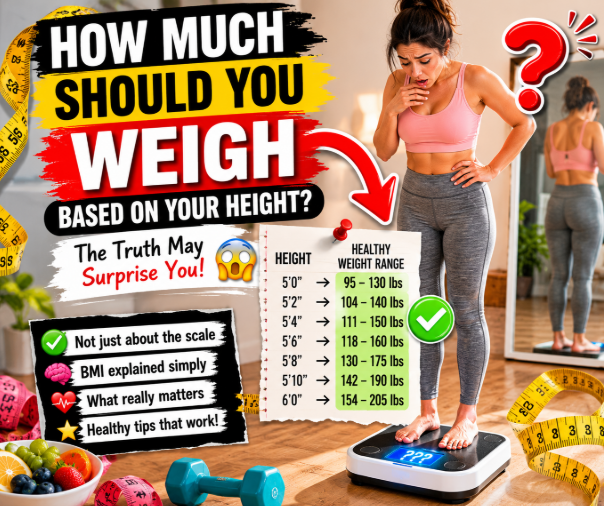
One of the most searched health questions online is surprisingly simple:
“How much should I weigh for my height?”
Millions of people search for weight charts every year hoping to find the “perfect” number. But the truth is, healthy weight is far more complicated than most charts make it seem.
Two people with the exact same height can look completely different, feel completely different, and still both be healthy.
That’s why more doctors and fitness experts are now encouraging people to stop obsessing over a single number on the scale and instead focus on overall health, body composition, lifestyle, and long-term habits.
Why Height and Weight Charts Became So Popular
Weight charts have existed for decades. Insurance companies and medical researchers originally created them to estimate general health risks across large populations.
Over time, these charts became incredibly common online because they offered simple answers to complicated health questions.
People liked the idea of quickly checking:
- height
- age
- weight
…and instantly finding out whether they were considered “underweight,” “normal,” or “overweight.”
But human bodies are far more unique than simple charts can explain.
The Number on the Scale Doesn’t Tell the Whole Story
One of the biggest misconceptions about weight is that a single number automatically determines health.
In reality, many factors influence what a healthy weight looks like, including:
- muscle mass
- genetics
- age
- body structure
- activity level
- metabolism
For example, athletes often weigh more than expected because muscle is denser than fat. Meanwhile, two people with the same weight can carry it very differently depending on body composition.
That’s why experts say focusing only on weight can sometimes create unrealistic expectations.
BMI Is Useful — But Not Perfect
Many online calculators use something called BMI, or Body Mass Index, to estimate whether someone falls within a healthy range.
BMI compares height and weight using a mathematical formula.
BMI=height(m)2weight(kg)
While BMI can be useful as a general guide, health experts often point out that it has limitations.
For example, BMI does not measure:
- muscle mass
- body fat percentage
- fitness level
- bone density
That means someone who is physically fit and muscular could technically fall into a “higher” BMI category despite being healthy.
Social Media Has Changed Body Expectations
Another reason people constantly search for ideal weight is because social media has dramatically changed body image standards.
Perfectly edited photos, fitness influencers, and unrealistic beauty trends often make people feel pressure to achieve a certain appearance rather than focus on actual health.
Many experts now warn that comparing your body to strangers online can create unhealthy habits and unrealistic goals.
What looks healthy for one person may not be healthy for another.
Health Is About More Than Appearance
Doctors increasingly emphasize that true health goes beyond body size alone.
Factors like:
- energy levels
- sleep quality
- blood pressure
- mental health
- nutrition
- exercise habits
often matter far more than trying to reach a specific number on the scale.
Someone can technically fall into a “healthy” weight range while still having poor eating habits, low fitness, or underlying health issues.
At the same time, someone slightly above traditional weight charts may still be physically active and healthy overall.
Why Sustainable Habits Matter Most
Crash diets and extreme weight-loss plans continue going viral online, but experts say long-term consistency matters far more than rapid results.
Healthy habits usually include:
- balanced nutrition
- regular movement
- quality sleep
- stress management
- staying hydrated
Instead of chasing unrealistic body standards, many health professionals encourage focusing on habits that improve overall wellbeing over time.
The goal should not simply be looking thinner.
The goal should be feeling healthier, stronger, and more energetic.
There Is No “Perfect” Number for Everyone
Perhaps the most important thing people forget is that healthy bodies come in different shapes and sizes.
A number on a chart cannot fully measure confidence, strength, energy, happiness, or overall quality of life.
Weight calculators and charts can be helpful tools, but they should never become the only definition of health.
At the end of the day, the healthiest weight for you is usually the one that allows you to live well, stay active, and feel physically and mentally strong — not simply the number someone else expects to see on a scale.