

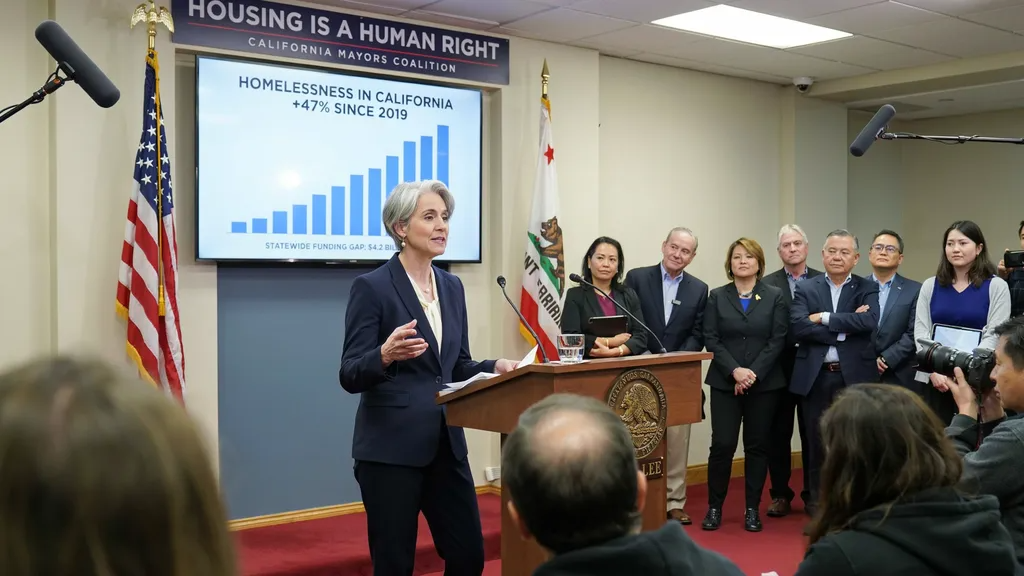
In late March 2026, a bipartisan coalition of mayors from California’s 13 largest cities traveled to Sacramento to call on state leaders to restore and stabilize funding for the Homeless Housing, Assistance and Prevention (HHAP) program.
State officials are currently planning to reduce HHAP funding to $500 million for the 2026–27 fiscal year, a 50% cut from the roughly $1 billion allocated annually in recent years.
The delegation was led by Riverside Mayor Patricia Lock Dawson and included Sacramento Mayor Kevin McCarty, San Diego Mayor Todd Gloria, Anaheim Mayor Ashleigh Aitken, Oakland Mayor Barbara Lee, Stockton Mayor Christina Fugazi, San Jose Mayor Matt Mahan, Long Beach Mayor Rex Richardson, and Irvine Mayor Larry Agran, among others.
Together, the mayors are urging both the Legislature and the governor’s office to restore HHAP funding to $1 billion per year and commit to maintaining that level on an ongoing basis.
Their appeal comes as state data shows a 9% decline in unsheltered homelessness in 2025—a trend Governor Gavin Newsom has pointed to as evidence that current strategies are making progress.
“These cuts put critical programs and real progress at risk, sending a message that reducing homelessness is no longer a priority for the state,” said Lock Dawson, mayor of Riverside. She warned that without legislative action, the funding reduction could eliminate up to 6,000 shelter beds across the 13 cities and leave an estimated 41,000 people at risk of returning to homelessness. “HHAP works, and it’s been working.”
The mayors also highlighted the broader drivers of homelessness, including rising rents, job loss, evictions, and behavioral health challenges, which continue to strain local systems even amid recent improvements in statewide numbers.
Despite the reported overall decline, racial disparities remain stark across many cities, particularly among Black Californians. In Oakland, for example, Black or African American residents make up about 22% of the population but account for more than half of the city’s homeless population, including a disproportionately high share of unsheltered individuals and first-time homelessness cases. Officials and advocates often link this imbalance to long-term displacement pressures, housing instability, and the lasting economic effects of past foreclosure crises.
In August 2025, then–U.S. Representative Barbara Lee announced the creation of the Office of Homelessness Solutions in Oakland to coordinate and streamline the city’s response across services such as encampment management, emergency shelters, and permanent housing programs.
Lee, who won a special election in April 2025, warned that a significant reduction in state HHAP funding could force Oakland to scale back its homelessness efforts by as much as 50% over the next five years. She emphasized that progress depends on a comprehensive racial equity approach embedded across all levels of government and housing programs.
“Fifty percent is not enough for me, personally,” Lee said. “But achieving even that level of reduction in Oakland requires a racial equity approach at every level of government through our programs that prevent homelessness and create more housing opportunities. I can’t accomplish any of this without HHAP funding.”