

Have you ever scrolled through social media and suddenly felt like everyone around you has more friends, more invitations, and a more active social life than you?
As it turns out, that feeling may not just be insecurity.
There is actually a real scientific concept called the Friendship Paradox, and researchers say it helps explain why so many people believe their friends are more popular than they are. Surprisingly, the phenomenon has been studied for decades and is rooted in mathematics rather than personal success or social status.
For many people, learning about the friendship paradox feels strangely comforting because it reveals that this experience is far more common than most realize.
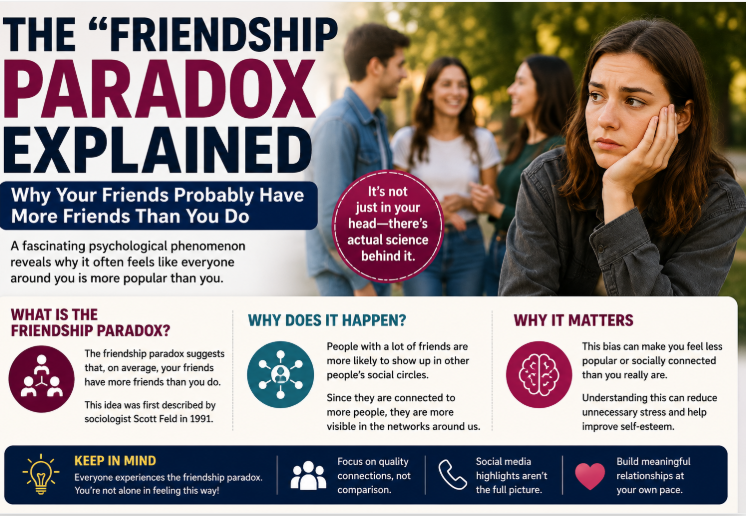
What Is the Friendship Paradox?
The friendship paradox was first described by sociologist Scott Feld in 1991.
The idea is simple:
On average, your friends are likely to have more friends than you do.
At first, that sounds impossible.
How can most people have friends who are more popular than they are?
The answer comes down to how social networks work.
People who have a large number of friends naturally appear in more friendship circles. Because they are connected to more people, they are statistically more likely to show up in someone else’s social network.
In simple terms, highly social people are overrepresented in the friendships we observe around us.
Why It Feels Like Everyone Else Is More Popular
Imagine two people:
One person has five friends.
Another person has fifty friends.
The individual with fifty friends will appear in many more social circles and interactions simply because they know more people.
As a result, when you look around at your friend group, you are more likely to notice people who are already highly connected. That creates the illusion that most people are more popular than you, even when that is not actually true for the overall population.
Researchers describe this as a type of sampling bias.
You are not seeing the full picture — you are mostly seeing the people who are easiest to notice socially.
Social Media Makes the Feeling Stronger
Many experts believe social media has amplified the friendship paradox dramatically.
Platforms like Instagram, TikTok, Snapchat, and Facebook constantly expose users to the most visible moments of other people’s lives.
People often share:
- vacations
- parties
- celebrations
- achievements
- social gatherings
Meanwhile, quieter everyday moments rarely get posted.
Because of that, users can begin feeling as though everyone else is constantly surrounded by friends and exciting experiences.
In reality, most people are only seeing a carefully selected highlight reel.
The friendship paradox helps explain why those comparisons can feel so convincing.
Why This Matters for Mental Health
Psychologists have long studied how social comparison affects self-esteem.
When people repeatedly believe others are more successful, happier, or more socially connected, it can increase feelings of loneliness and self-doubt.
The friendship paradox does not mean those feelings are irrational.
Instead, it suggests that human perception is often influenced by the structure of social networks themselves.
Understanding that bias can help people view social comparisons more realistically.
You Are Probably Not As Alone As You Think
One of the most interesting parts of the friendship paradox is that many people experience the same feeling simultaneously.
In other words:
A large number of people may believe their friends are more popular than they are — even when many of those friends secretly feel the exact same way.
That realization can be surprisingly reassuring.
Researchers say the paradox is less about actual popularity and more about how human networks naturally distort perception.
Why the Concept Keeps Going Viral
The friendship paradox continues gaining attention online because people instantly recognize themselves in it.
Many users react with comments like:
- “This explains everything.”
- “I thought it was just me.”
- “Now social media makes more sense.”
The theory combines psychology, mathematics, and everyday experience in a way that feels both surprising and relatable.
That combination is exactly why it continues spreading across social media years after researchers first described it.
Final Thoughts
The next time it feels like everyone around you has more friends, more plans, or a bigger social life, remember that your brain may be experiencing a well-known statistical illusion.
The friendship paradox suggests that many of us naturally see the most socially connected people more often, making them seem far more common than they actually are.
It is not proof that everyone else is more popular.
It may simply be proof that social networks are much stranger than they appear.
FAQ
Is the friendship paradox real?
Yes. Researchers have studied it for decades, and it is supported by mathematical models of social networks.
Does it mean my friends are actually more popular?
Not necessarily. It means highly connected people appear more often in social networks, creating a perception bias.
Why does social media make it worse?
Because platforms tend to highlight visible social activity, making other people seem more connected than they may actually be.